
Blog
Panjshir Valley Emerald: Afghanistan’s Legendary Gem


High in the Hindu Kush mountains, where the air is thin and the terrain nearly impassable, lies one of the most storied gem deposits on Earth. The Panjshir Valley emerald has captivated mineralogists, jewelers, and collectors for decades, prized for a saturated green color that rivals — and sometimes surpasses — the finest stones from Colombia. For collectors searching for a specimen with genuine rarity, geological pedigree, and a story worth telling, few gems compare to an emerald pulled from the Panjshir. In this guide, we’ll explore where these emeralds come from, what makes them so special, how to tell an authentic specimen from an imitation, and why serious collectors are adding Panjshir emeralds to their portfolios.
Where Panjshir Valley Emeralds Come From
The Panjshir Valley sits roughly 100 kilometers northeast of Kabul, Afghanistan, cutting through the rugged Hindu Kush range. Emerald-bearing veins run through the valley’s metamorphic marble and schist formations, deposited by hydrothermal activity along a major regional fault system millions of years ago. It’s a similar geological story to Colombia’s legendary Muzo mine — a hydrothermal emerald deposit rather than the pegmatite-hosted emerald found in places like Brazil or Zambia, which is part of why gemologists so often draw comparisons between the two.
Mining here is almost entirely artisanal. Local miners work by hand with simple tools, following narrow veins deep into the mountainside — a method that has changed remarkably little in the last half-century. It’s slow, dangerous, and low-yield work, which is exactly why fine specimens from this region remain so scarce on the open market.
A History Written in Green
Green stones from the region now known as Afghanistan were referenced by the Roman naturalist Pliny the Elder nearly two thousand years ago, describing “smaragdus” — emerald and emerald-like green minerals, coming from the ancient territory of Bactria. Whether those particular stones came from the Panjshir itself is debated among historians, but it places emeralds from this part of the world in the historical record long before modern mining began.
The Panjshir Valley’s known commercial emerald production is far more recent. Systematic exploration began in the early 1970s, with a notable discovery near the Buzmal mine east of Dest-e-Rewat village, and Soviet geologists conducted early surveys of the region’s gem potential around the same time. Full commercial-scale mining took hold in the early 1980s, and for decades since, emeralds have been one of the valley’s most economically significant resources — mined largely by small, family- and tribal-based operations passed down through generations.
Every Panjshir emerald that reaches a collector’s hands today carries that history: hand-dug from a remote mountainside by miners continuing a craft that predates most modern nations.
What Makes a Panjshir Emerald Different
Not all emeralds are created equal, and Panjshir stones have a distinct fingerprint that experienced collectors learn to recognize:
- Color saturation: Panjshir emeralds are known for a deep, slightly bluish-green hue with excellent
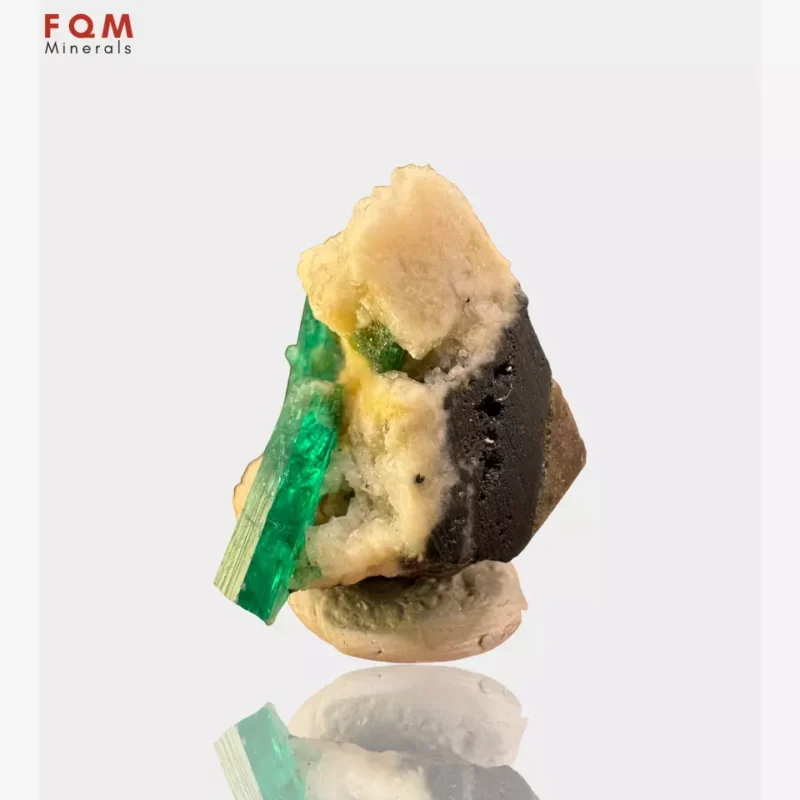
saturation, often described as comparable to top-tier Colombian material. - Color zoning: It’s common to see the outer “skin” of a rough Panjshir crystal appear darker than its interior,
a distinctive trait of the deposit. - Clarity character: Like most fine emeralds, Panjshir stones typically show natural inclusions (sometimes
called jardin, French for “garden”). Emeralds are graded for clarity by eye rather than under magnification, so
a stone with no inclusions visible to the naked eye is considered exceptional regardless of origin. - Crystal habit: Rough specimens often present as well-formed hexagonal prisms, which is part of what
makes uncut Panjshir crystals so desirable as display specimens, not just cutting rough.
If you want to see how emeralds stack up against other colored stones in terms of rarity and market behavior, our guide on investment-grade colored gems breaks down what collectors should be watching for across categories.
Are Panjshir Emeralds a Good Investment?
Fine mineral specimens, and fine emeralds in particular, have increasingly caught the attention of collectors treating their acquisitions as tangible, long-term assets. Panjshir emeralds sit at an interesting intersection of two forces that tend to drive appreciation: geological scarcity and geopolitical scarcity. The deposit itself is naturally limited, mining conditions are difficult, and export logistics from the region are far from straightforward, all of which keep verified, well-documented Panjshir material in short supply relative to demand.
For collectors, this means a well-provenanced, natural, untreated Panjshir emerald specimen, particularly one with strong color and eye clarity, tends to hold and grow in value more reliably than mass-market, heavily treated commercial emeralds. It’s a similar dynamic to what we outline in our roundup of the top 20 most exquisite gemstones and rare minerals, where origin and rarity consistently outweigh size alone.
How to Identify an Authentic Panjshir Emerald?
Because fine emeralds command such high prices, the market unfortunately has no shortage of synthetic stones, undisclosed treatments, and mislabeled origins. Here’s what to look for before you buy: Ask for documented provenance. A reputable dealer should be able to tell you exactly where and how the specimen was sourced.
Look for natural inclusions. A completely “flawless” emerald under magnification is a red flag for synthetic material; natural Panjshir stones almost always show some internal characteristics.
Check for disclosed treatments. Oil or resin treatment to improve clarity is common industry practice and isn’t inherently a problem, but it must be disclosed. Ask directly.
Buy from a dealer who offers authentication and guarantees. A lifetime authenticity guarantee and a genuine return policy tell you a lot about how confident a seller is in what they’re selling. This is exactly the standard we hold ourselves to. Every specimen in our emerald collection, including material from the Panjshir Valley, comes with a lifetime authenticity guarantee and our 80-day no-questions-asked return policy, because we believe collectors deserve total confidence in what they’re acquiring.
Why Collectors Trust Fine Quality Minerals for Afghan Emeralds
Our relationship with fine minerals goes back over 50 years, beginning with our late grandfather, Arifullah, who supplied minerals for some of the most respected names in the trade. That heritage means direct relationships with miners and sourcing networks across Pakistan and Afghanistan — including the Panjshir Valley — rather than buying blind through intermediaries. You can read more about that story on our About Us page.
If you’re drawn to emerald for more than its rarity, many collectors also connect with it through the Taurus birthstone tradition, where Panjshir emerald is considered a natural fit.
Caring for Your Emerald Specimen
Emeralds score 7.5–8 on the Mohs hardness scale, which sounds durable, but their natural inclusions and fractures make them more brittle than their hardness number suggests. A few care basics: Avoid ultrasonic or steam cleaners — the heat and vibration can worsen internal fractures. Clean gently with a soft, damp cloth. Skip harsh chemicals entirely.
Store specimens separately, wrapped or cushioned, to prevent surface-to-surface contact with harder stones. Keep out of direct, prolonged sunlight, which can affect oil or resin fillers over time
Frequently Asked Questions
What makes Panjshir Valley emeralds so valuable?
Their combination of deep, saturated color, historical mining significance, and genuine scarcity — driven by difficult terrain and limited artisanal output- makes verified Panjshir material highly sought after by collectors and investors alike.
How can I tell if an emerald is really from the Panjshir Valley?
Origin is best confirmed through a dealer with direct sourcing relationships and documented provenance, ideally paired with gemological
characteristics consistent with the deposit, such as its typical color zoning.
Are Panjshir emeralds treated?
Like the vast majority of fine emeralds worldwide, many Panjshir stones are treated with oil or resin to improve visible clarity. This should always be disclosed by the seller.
Is it legal to buy emeralds from Afghanistan?
Reputable dealers work through established, legitimate sourcing and export channels. Always buy from a company with a transparent history and verifiable business practices.
Own a Piece of the Hindu Kush
A Panjshir Valley emerald isn’t just a gemstone; it’s a fragment of one of the most difficult, storied mining regions on the planet, shaped by geology and hand-mined by families who have worked these mountains for generations. If you’re ready to add one to your collection, browse our current emerald specimens, explore our full mineral shop, or make an offer on a piece that catches your eye. Have questions before you buy? Check our FAQs or contact our team directly; no bots, just gemologists.