
Blog
Beyond Black: Discovering the World’s Finest Tourmaline Stones

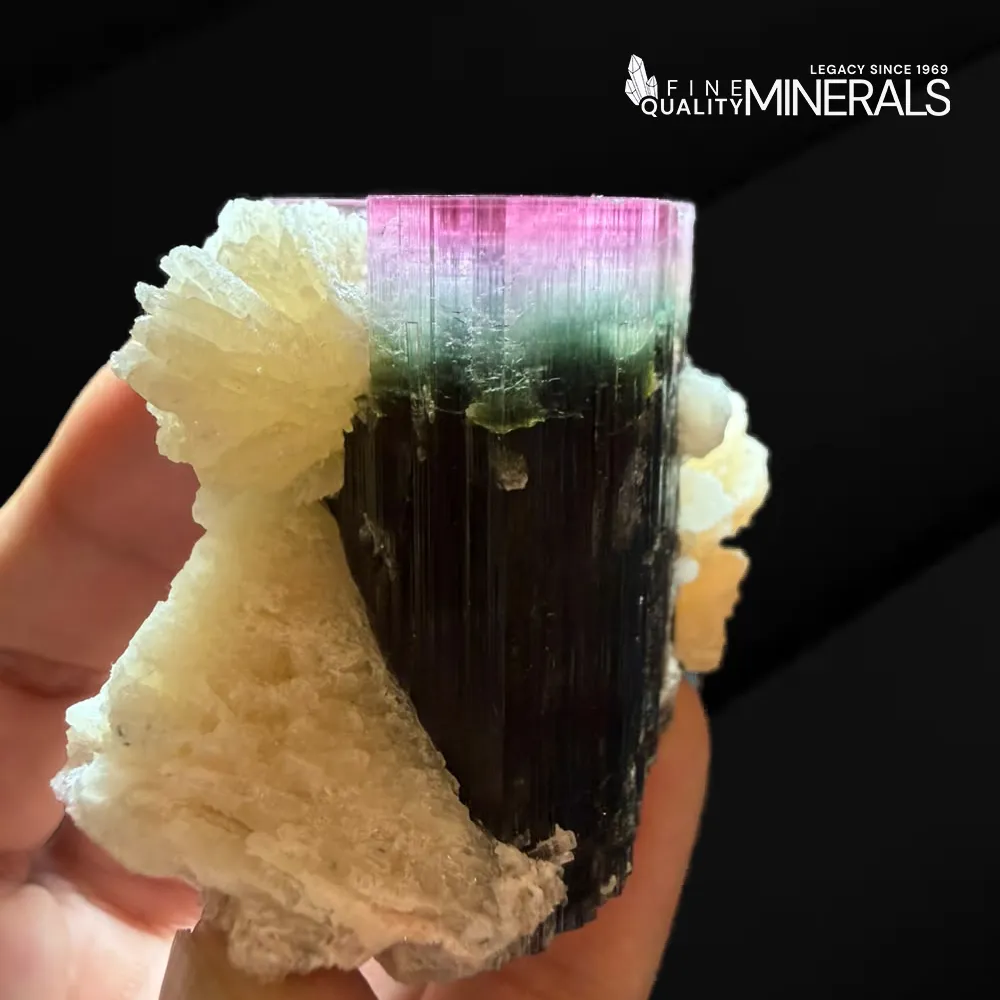
For generations, the term tourmaline stone predominantly evoked images of opaque, dense black schorl—celebrated for structural shielding and grounding properties. While black schorl remains geologically vital, elite collectors, investors, and gemological curators recognize that the true zenith of the species lies far beyond black.
The tourmaline supergroup encompasses some of the most vibrant, structurally complex, and aesthetically dazzling fine minerals on Earth. From the neon blues of indicolite to the saturated crimsons of rubellite and the intricate geometries of bi-color crystals on matrix, natural tourmaline crystal specimens represent the absolute pinnacle of aesthetic mineral collecting.
1. The Complex Mineralogy of Tourmaline
Tourmaline is not a single mineral species; rather, it is a complex family of boron-bearing cyclosilicate minerals compounded with aluminum, iron, magnesium, sodium, lithium, and potassium. Crystallizing in the trigonal system, tourmaline forms prismatic, vertically striated columnar crystals that range from needle-thin sprays to massive, blocky prisms.
Chemical Supergroup Formula
Where:
- A = Ca, Na, K, or vacancy
- D = Al, Fe2+, Fe3+, Li, Mg2+, Mn2+, Ti4+
- G = Al, Cr3+, Fe3+, V3+
- Y = O, OH
- Z = F, O, OH
The Elbaite Difference
Among the primary tourmaline species—Schorl, Dravite, Uvite, Liddicoatite, and Elbaite—Elbaite is the undisputed crown jewel for collectors seeking museum-grade raw crystals. Elbaite is lithium-rich, an elemental distinction that allows a dynamic range of chromatic trace elements to enter the crystal lattice during hydrothermal crystallization, yielding unparalleled transparency and color diversity.
2. The Elite Color Spectrum: Beyond Ordinary Hues
The visual majesty of a high-grade tourmaline stone is dictated entirely by its chromophores—trace transition metals trapped within the silicate framework during cooling.
| Variety Name | Primary Chromophore | Dominant Color Profile |
|---|---|---|
| Rubellite | Manganese (Mn3+) | Hot pink, crimson, deep purplish-red |
| Indicolite | Iron (Fe2+ to Fe3+) | Deep denim, teal, electric neon blue |
| Verdelite | Iron (Fe2+) / Chrome | Emerald green, olive, deep forest |
| Watermelon | Mn core / Fe-Cr rim | Pink interior with green outer rim |
| Paraíba Type | Copper (Cu2+) | Vivid turquoise, neon cyan, electric |
Rubellite
True rubellite is defined by its ability to hold its rich, warm color under all lighting conditions. While standard pink tourmaline shifts toward brownish tones under incandescent light, authentic rubellite blazes with saturated ruby-pink intensity.
Indicolite
Among the rarest non-copper varieties, indicolite ranges from deep ocean teal to crystal-clear cerulean. Tabular indicolite formations with intact terminations are among the most competitive mineral specimens for sale on the global auction market.
Polychrome & Watermelon Tourmaline
Polychrome tourmalines exhibit distinct chromatic zoning along their vertical c-axis or concentric radial growth rings. This occurs when the geochemical composition of the hydrothermal fluid pocket shifts during the millions of years the crystal takes to form. A transition from deep teal to vivid mint green, or pink to green, preserves a frozen chronological record of the Earth’s thermal dynamics.
3. The Power of Matrix: Why Host Rock Elevates Value
In commercial jewelry, cut gemstones are evaluated almost entirely by the 4 Cs (Color, Cut, Clarity, Carat). In the realm of elite fine minerals, the equation changes entirely: Matrix is paramount.
A loose, detached crystal—regardless of its clarity—has lost much of its geological context. An investment-grade specimen featuring a gem-quality crystal perched naturally upon its original matrix represents geological serendipity.
Critical Matrix Associations
- Cleavelandite (Bladed Albite): The snow-white, fan-like plates of cleavelandite create stark, dramatic visual contrast against saturated pink and deep green tourmaline prisms.
- Faceted Quartz: Specimens where tourmaline prisms shoot directly through or rest flush against sharp smoky or transparent quartz matrices showcase geometric equilibrium.
- Lepidolite & Mica: Lilac lepidolite flakes or golden muscovite books provide textural depth, proving the specimen was extracted from a rich lithium pegmatite pocket without artificial alteration.
4. Key Provenance: Paprok, Kunar, and the Hindu Kush
In high-end mineral collecting, provenance dictates liquidity, historical importance, and price ceilings. While Brazil and Madagascar produce extraordinary minerals, the high-altitude alpine pegmatites of Afghanistan and Pakistan remain legendary.
- Paprok (Nuristan, Afghanistan): Internationally renowned as the undisputed capital for exquisite, multi-colored elbaite specimens. Paprok tourmalines are famous for their flawless, glass-like terminations, pastel “cotton candy” color zoning, and complex associations with cleavelandite.
- Stak Nala (Gilgit-Baltistan, Pakistan): Famous for iconic bi-color tourmalines featuring deep green bodies capped with sharp, velvety black or dark green terminations, often perched on pure white albite.
- Dara-e-Pech (Kunar, Afghanistan): Known for producing exceptionally thick, gem-grade verdelite and indicolite prisms with high optical transparency.
5. Investment Grading: Evaluating Museum-Grade Specimens
When evaluating natural minerals for sale, discerning collectors utilize five fundamental criteria to determine whether a specimen qualifies as commercial grade or a true investment-level asset:
- Termination Integrity: The termination (the natural crystal tip) must be pristine. A single chip or contact bruise on the primary termination drastically impacts valuation.
- Optical Clarity & Pleochroism: High-grade tourmaline displays pronounced pleochroism, exhibiting different color depths when viewed down the c-axis versus the side prisms.
- Zero Artificial Enhancement: Many commercial stones undergo heavy gamma irradiation or heat treatment to brighten poor color. Elite collectors demand 100% untreated, unheated, all-natural specimens direct from the mine.
Frequently Asked Questions
What makes a tourmaline stone valuable compared to other minerals?
A tourmaline stone derives its high market value from its complex chemical diversity, vitreous luster, extreme color variety, and structural rarity. Natural crystals that exhibit multiple colors on a single undamaged prism—especially when preserved on their natural matrix—are among the rarest mineral formations on Earth.
How do I identify an authentic, unheated tourmaline crystal?
Authentic raw crystals exhibit natural vertical striations along the prism faces, asymmetric trigonal terminations, natural internal growth veils, and distinct pleochroism. Artificially treated or synthetic crystals often lack natural matrix attachments, show unnaturally uniform color saturation without zoning, or display microscopic stress fractures caused by heat treatment.
Why are matrix-attached mineral specimens more expensive than loose stones?
Matrix specimens require extreme care and artisan skill to extract by hand without damaging the delicate crystal attachment. Preserving a natural crystal on its host albite or quartz rock maintains its complete geological provenance, rarity, and sculptural display appeal, commanding a premium over loose crystals.
How should I care for and display my fine mineral specimens?
Tourmaline rates 7 to 7.5 on the Mohs hardness scale, making it durable yet susceptible to thermal shock and hard impacts. Keep your specimens away from direct, high-heat halogen spotlights and ultrasonic cleaners. Dust gently using a soft, natural-bristle brush and display inside a UV-protected, humidity-stable vitrine or cabinet.
Discover Investment-Grade Tourmaline at Fine Quality Minerals
Are you ready to elevate your personal gallery or investment portfolio with authentic, world-class geological treasures?
At Fine Quality Minerals, we leverage over 55 years of direct mine-to-market heritage to bring elite collectors pristine, 100% natural mineral specimens for sale. Every single specimen in our vault—from vibrant Paprok bicolor tourmalines to massive matrix masterworks—is ethically sourced, thoroughly authenticated, and completely damage-free.