
Blog
Aquamarine Crystals Guide: Meaning, Geological Properties, and Specimen Value

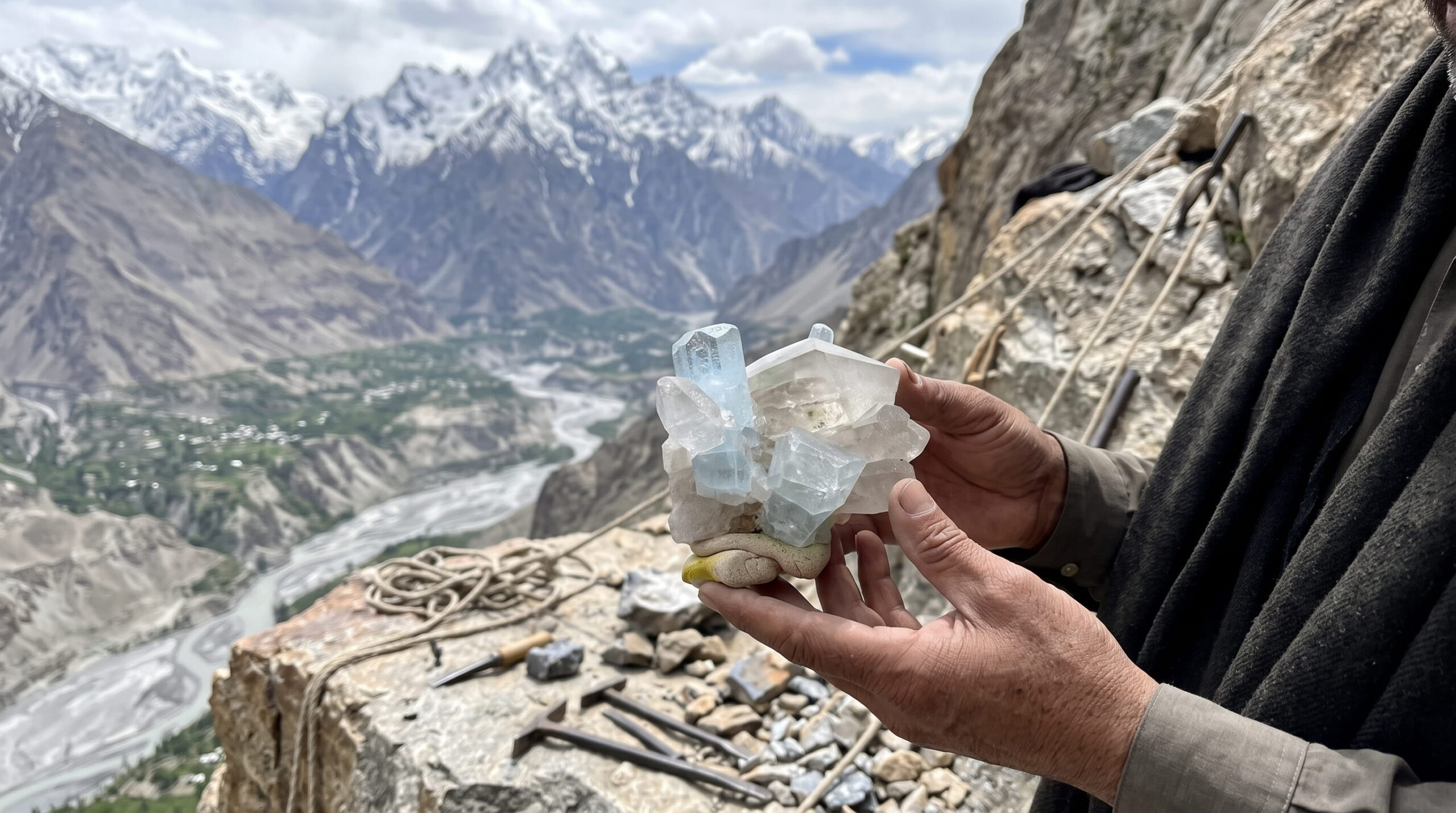
Aquamarine Crystals: Complete Guide to Meaning, Geological Properties, and Collector Value
Aquamarine crystals stand among the most sought-after treasures of the mineral kingdom[cite: 11]. Celebrated for centuries as a gemstone of maritime lore and the official birthstone for March[cite: 11], natural aquamarine is first and foremost a beryl mineral formed under extreme geological conditions inside granitic pegmatites.
Whether you are evaluating a raw rough aquamarine matrix specimen from the Karakoram ranges or exploring the historical aquamarine stone meaning[cite: 11], this comprehensive guide examines its chemical makeup, world-renowned localities, evaluation metrics, and current market pricing.

1. What Are Aquamarine Crystals? (Mineralogy & Properties)
Aquamarine is the light-blue to rich sea-green variety of the Beryl mineral family[cite: 11]. Its chemical composition is beryllium aluminum silicate, expressed formulaically as:
Be₃Al₂(SiO₃)₆Beryllium Aluminum Cyclosilicate
The distinct coloration of natural blue aquamarine originates from trace iron ions ($Fe^{2+}$ and $Fe^{3+}$) substituted into channel sites of the hexagonal crystal lattice. Ferrous iron ($Fe^{2+}$) yields the desired pure sky-blue coloration, while ferric iron ($Fe^{3+}$) introduces greenish undertones, yielding green aquamarine crystal variations[cite: 11].
Hexagonal (dihexagonal bipyramidal)
7.5 to 8.0
2.66 – 2.80
Vitreous (glassy)
1.577 – 1.583
2. Aquamarine Stone Meaning, Lore & Cultural History
Derived from the Latin aqua marina (“water of the sea”), blue beryl carries thousands of years of recorded lore across civilisations:
- Maritime Guardian: Ancient Mediterranean seafarers carried raw aquamarine crystals as talismans against storms and maritime perils[cite: 11].
- Symbol of Marital Harmony: Medieval European lapidaries prized the stone as a promise of enduring fidelity and intellectual clarity[cite: 11].
- Astrological Sign: Globally recognized as the primary birthstone for March, traditionally associated with Pisces and Scorpio[cite: 11].
In holistic circles, aquamarine is said to represent tranquility, authentic expression, and mental stillness[cite: 11]. According to mineral databases cataloged by the Mindat Mineralogy Database, beryl specimens from alpine pockets remain definitive examples of undisturbed crystallization.
3. World-Famous Pegmatite Localities
Fine collector-grade aquamarine crystallizes inside miarolitic pockets of granitic pegmatites. The world’s most dramatic specimens come from a small handful of alpine and mountain environments:
Skardu & Shigar Valley (Pakistan)
Famous for transparent, glassy hexagonal prisms resting on snowy albite (cleavelandite) rosettes and muscovite books. These specimens are recognized worldwide for pristine architectural aesthetics.
Nuristan & Kunar (Afghanistan)
Known for elongated, gem-grade prisms often found alongside polychrome tourmalines, kunzite, and pink morganite.
Minas Gerais (Brazil)
Historic producer of monumental single crystals and massive gem rough suited for museum display and lapidary cutting.
4. Pricing Matrix: What Determines Specimen Value?
Broad internet searches for aquamarine crystal price often conflate mass-market tumbled beads with collector-grade mineral specimens[cite: 11]. High-end values are determined by clarity, natural matrix preservation, and intact terminations.
| Quality Tier | Visual Characteristics | Typical Application | Market Price Range (USD) |
|---|---|---|---|
| Commercial Rough | Opaque, heavily fractured, pale grayish-blue[cite: 11] | Tumbled stones, carving, beads[cite: 11] | $10 – $80[cite: 11] |
| Cabinet Crystal (Single) | Translucent to transparent, minor contact on base, terminated[cite: 11] | Private collector cabinets, study pieces | $150 – $1,200 |
| Fine Matrix Specimen | Water-clear prism, undamaged termination, on native cleavelandite[cite: 11] | High-end investment display, galleries | $2,500 – $12,000 |
| Museum-Grade Centerpiece | Saturated sky-blue, exceptional termination, undamaged aesthetic matrix | Institutions, flagship collections | $15,000 – $60,000+ |
Interactive comparison of market valuation based on natural crystallization grade and provenance.
5. Identifying Authenticity & Disclosed Repairs
Because high-end alpine specimens command five-figure valuations, authentication is vital for collectors:
- Thermal Enhancement Checks: Low-temperature heating (approx. 400°C) is widely applied to cut stones to strip out yellow/green components. Fine mineral specimens must remain unheated.
- Matrix Re-attachments: Alpine pocket extraction in steep Karakoram elevations occasionally causes crystals to detach. Reputable dealers rigorously disclose any professional stabilization or re-attachment under UV inspection.
- Crystal Morphology: Natural beryl crystallizes in parallel hexagonal prisms with striations running along the c-axis, distinguishing it from molded glass simulants. Read more about crystal structures via the Gemological Institute of America (GIA).