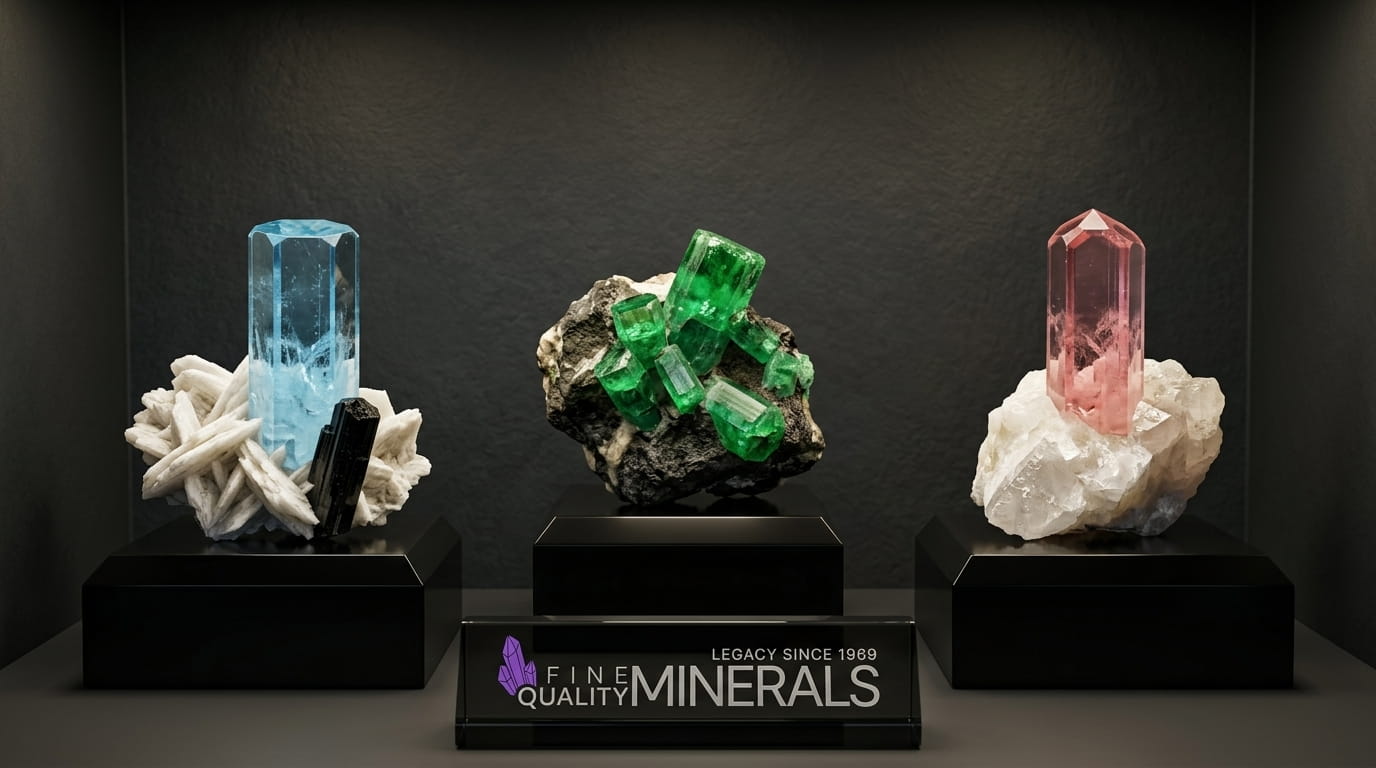
Blog
Aquamarine from Skardu Pakistan: Karakoram Collector Beryl Guide

Aquamarine from Skardu Pakistan: Why High-Altitude Karakoram Beryl Commands Top Collector Value
Among the elite echelons of international mineral collecting, authentic aquamarine from Skardu Pakistan stands as the ultimate benchmark of alpine crystallization. Perched amidst the glacial terrain of the Karakoram Range, the miarolitic pockets of the Skardu District and the rugged valleys of Gilgit-Baltistan yield what museum curators and connoisseurs consider the pinnacle of natural beryl: untreated, gem-clear crystals preserved intact upon pristine native matrix.
While commercial markets facet lower-grade rough into calibrated jewelry stones, fine mineral collectors operate on entirely different aesthetic principles. For discerning connoisseurs, securing authentic collector grade beryl preserved exactly as nature formed it alongside paragenetic matrix minerals is infinitely rarer—and routinely commands values far exceeding cut stones.
The Geological Crucible of Pakistani Pegmatite Minerals
The genesis of world-class Pakistani pegmatite minerals is tied directly to the monumental tectonic collision between the Indian and Eurasian plates. This continental compression created the Karakoram metamorphic complex, generating late-stage granitic pegmatites saturated with volatile elements, beryllium, and boron.
At extreme elevations between 12,000 and 16,000 feet, gem beryls crystallized within undisturbed hydrothermal pockets over millions of years. This unique geology produces the signature morphology that makes natural aquamarine from Skardu Pakistan legendary worldwide:
- Elongated Hexagonal Prisms: Classic six-sided columnar prisms displaying mirror-like crystal faces and water-clear optical transparency.
- Pinacoidal and Modified Terminations: Pristine, flat pinacoid terminations often enhanced by complex pyramidal bevels that reflect light with razor-sharp geometric precision.
- Unaltered Natural Color: Ranging from pale glacial ice to saturated sea-foam azure, completely free from the artificial heat treatments typical in commercial gemstone channels.
Localities of Distinction: Shigar Valley and Beyond
While Skardu serves as the primary regional trading hub, seasoned collectors evaluate specimens according to specific alpine pegmatite deposits across Baltistan:
1. Shigar Valley Aquamarine (Dassu & Alchuri Fields)
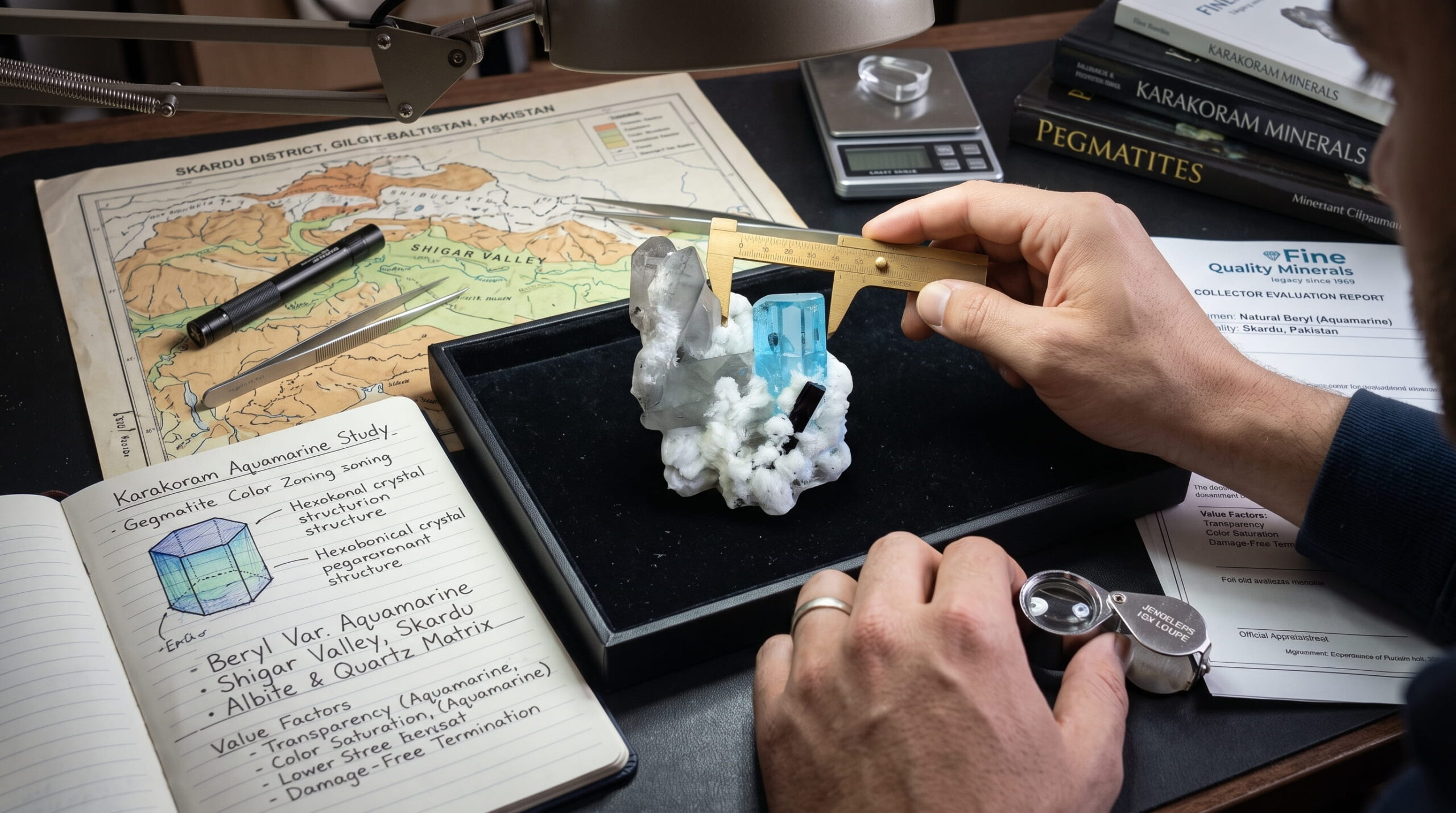
The Dassu pegmatite belt is universally celebrated for producing classic aesthetic pairings. World-class Shigar Valley aquamarine specimens are distinguished by luminous, glassy crystals nestled amongst snow-white bladed cleavelandite (albite) and reflective books of silvery muscovite mica. In prime specimens, lustrous black schorl (tourmaline) needles weave through the matrix, creating dramatic visual contrast.
2. Shengus & the Haramosh Massif
Positioned along the Indus River corridor, Shengus is known for yielding highly lustrous, transparent crystals with stark architectural matrix backings, celebrated for their clean geometry and gemmy interiors.
3. Nyet-Bruk & High-Altitude Alpine Pockets
These remote, high-altitude deposits produce crystals characterized by rich, natural saturation. They remain revered for their organic color depth without requiring the artificial gamma irradiation common in mass-market commercial crystals.
The Rarity and Value of Raw Aquamarine on Matrix
In fine mineral connoisseurship, nothing compares to an undamaged raw aquamarine on matrix. High-altitude pegmatite mining prohibits heavy machinery; local miners extract pockets entirely by hand with chisels and wedges along sheer mountain precipices. Successfully extracting a fragile crystal firmly attached to its host rock requires remarkable patience and skill.
A crystal preserved on its natural matrix tells the complete hydrothermal story of its formation. In competitive collecting, a 5 cm crystal anchored securely to an aesthetic bed of cleavelandite and mica is exponentially more valuable than an identical loose crystal that sheared off during recovery.
Specimen Appraisal Matrix: Museum Grade vs. Commercial Rough
| Valuation Criteria | Commercial Rough | Museum & Collector Grade |
|---|---|---|
| Host Matrix | Loose, detached, or repaired matrix chunk | Naturally attached raw aquamarine on matrix with zero artificial repairs |
| Termination Quality | Chipped, contacted, or cleaved terminations | 100% pristine, glass-sharp pinacoids without micro-fractures |
| Internal Optics | Milky, included, or heavily fractured | Optically transparent gem clarity with brilliant natural luster |
| Locality & Provenance | Generic, untraced commercial lots | Direct mine-to-market provenance verified as natural aquamarine from Skardu Pakistan |
Curating Authentic Himalayan Masterpieces
Whether you are building a focused regional cabinet of the Karakoram belt or assembling an elite display of global pegmatite treasures, acquiring authentic aquamarine from Skardu Pakistan represents an essential cornerstone. The interplay of cool geometric symmetry, immaculate terminations, and contrasting matrix topography captures the ultimate harmony of natural art and geological history.
Explore authentic, damage-free museum specimens in our curated Online Mineral Gallery, or contact our curators directly through our Acquisitions Desk for private collection inquiries.