Blog
Origins of Rubies: Geological Sources & Collector Valuation Guide

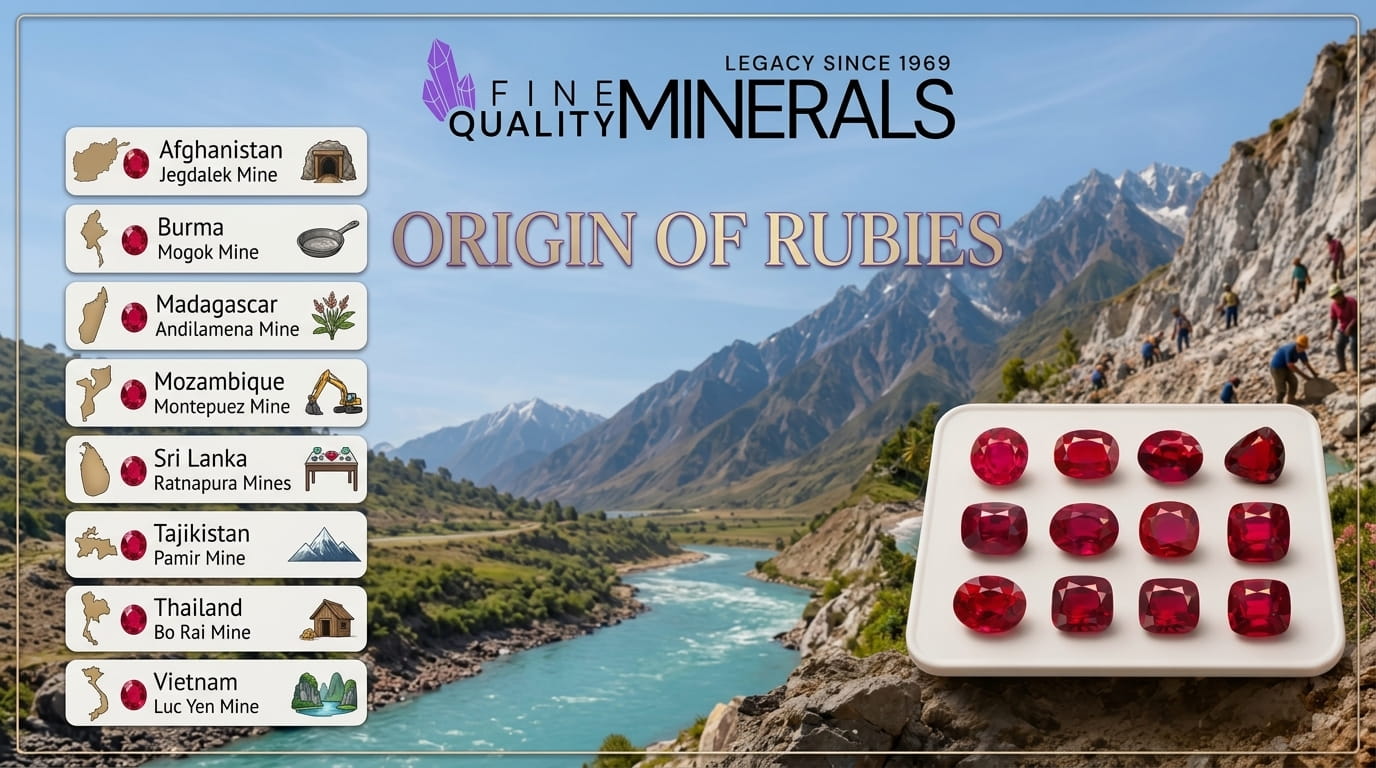
Few gemstones carry the weight of history and geology quite like ruby. The origins of rubies are written into the rock that hosts them — and for collectors, museums, and investors alike, knowing where a stone formed is often just as important as the stone itself. From the marble outcrops of the Hindu Kush to the basalt gravels of eastern Thailand, each ruby locality has its own chemistry, its own history, and its own place in the valuation hierarchy that shapes today’s market.
This guide walks through the world’s major ruby-producing regions, explains why marble-hosted rubies command a premium over their basalt-hosted counterparts, and gives collectors a practical framework for evaluating a natural raw ruby crystal — whether it’s a museum specimen or an investment-grade parcel stone.
What Determines a Ruby’s Origin — and Why It Matters
Ruby is red corundum (Al₂O₃), and its colour comes from trace amounts of chromium replacing aluminium in the crystal lattice. But the rock that hosts the corundum as it forms — the host lithology — has an outsized effect on quality, and it’s the first thing a gemological lab checks when issuing an origin report.
- Marble-hosted rubies form when aluminium-rich fluids react with iron-poor, calcium-carbonate marble during regional metamorphism. Because the host rock is low in iron, the resulting corundum is largely free of iron contamination — the element responsible for suppressing red fluorescence. This is the geological family behind Mogok, Jegdalek, Luc Yen, Andilamena, and the Pamir deposits, and it’s why these localities are so closely associated with the purest, most luminous reds in the trade.
- Basalt-hosted rubies crystallise as xenocrysts within alkali basalt flows and are later liberated by weathering into alluvial gravels. This is the setting behind most Thai and Cambodian production. Basaltic rubies tend to carry higher iron content, which mutes fluorescence and pushes colour toward darker, more brownish-red tones.
- Metamorphic (non-marble) deposits, such as the amphibolite-hosted rubies of Mozambique, sit somewhere between the two — capable of extraordinary size and clarity, with colour and fluorescence that vary by pocket and depth.
Understanding this distinction is the single most useful piece of mineralogy a new collector can learn, because it explains almost everything else about how rubies are priced.
The World’s Ruby Mines: A Locality-by-Locality Guide
 Jegdalek Mine, Afghanistan
 Jegdalek Mine, Afghanistan
Located in Surobi District, Kabul Province, roughly 60–70 km east of Kabul, Jegdalek is Afghanistan’s oldest and most important ruby locality, worked for at least a thousand years. A Jegdalek ruby specimen forms in elongate beds of calcite-to-dolomite marble within a metamorphic sequence of marbles and gneisses, the same geological family as Mogok. Ruby occurs with pink spinel, phlogopite, pyrite, and graphite in narrow veins and pocket-like lenses rather than continuous ore bodies, which is why fine crystallised specimens remain genuinely scarce even though the deposit has produced large total volumes of corundum. The finest material shows a saturated purplish-red to pigeon’s-blood colour with strong red fluorescence — collector-grade Jegdalek crystals on white marble matrix are among the most visually striking pieces in Asian ruby mineralogy, and decades of regional instability have kept supply well below the market’s appetite for them.
Mogok Mine, Burma (Myanmar)
 Mogok Mine, Burma (Myanmar)
Mogok is the benchmark against which every other ruby locality is measured. Mined for over 800 years in the Mogok Stone Tract of upper Myanmar, its rubies form in marble that is exceptionally low in iron, producing the famous “pigeon’s-blood” red — a pure, slightly purplish red with fluorescence so strong the stone appears to glow from within under natural light. Mogok’s geology also yields spinel, sapphire, and peridot from the same broader metamorphic belt, but ruby remains the locality’s defining export and the historical reference point for origin reports worldwide.
Andilamena Mine, Madagascar
 Andilamena Mine, Madagascar
Discovered in the late 1990s in the Alaotra-Mangoro region roughly 200 km north of Antananarivo, Andilamena helped establish Madagascar as a major corundum-producing nation. Ruby forms within Precambrian marble, gneiss, and calc-silicate rock through metasomatic reactions between aluminium-rich fluids and the carbonate host — geologically comparable to Mogok, though Andilamena material tends to run pinkish-red to purplish-red rather than the saturated pure red of the finest Burmese stones, and is often heavily included. It remains an important source of commercial and mid-range collector material, recovered from both primary marble pockets and secondary alluvial placers.
Montepuez Mine, Mozambique
 Montepuez Mine, Mozambique
Discovered in 2009 in the Cabo Delgado province, Montepuez has become the single largest ruby-producing region in the world by volume. Unlike the marble-hosted deposits above, Montepuez ruby forms in an amphibolite-metamorphic setting within the Mozambique Belt, capable of yielding exceptionally large, clean crystals. Colour and fluorescence vary considerably by pocket — some material rivals Burmese quality in saturation and glow, while other parcels carry higher iron content and a darker tone. This variability, combined with sheer scale of production, makes Montepuez central to today’s mid-market and high-end commercial ruby trade alike.
Ratnapura Mines, Sri Lanka
 Ratnapura Mines, Sri Lanka
Ratnapura — literally “City of Gems” — sits in Sri Lanka’s Sabaragamuwa Province and has been worked for well over a millennium. Sri Lankan ruby is recovered almost entirely from secondary alluvial gem gravels known locally as illam, concentrated by erosion from primary metamorphic sources in the surrounding highlands. Ratnapura rubies are typically lighter in tone than Burmese or Mozambican stones, often edging toward pinkish-red, but fine, more saturated material does occur and is prized for its clarity and classic old-world provenance.
Pamir Mine (Snezhnoe–Kukurt), Tajikistan
 Pamir Mine (Snezhnoe–Kukurt), Tajikistan
Tajikistan’s ruby belt lies in the Central and Eastern Pamir Mountains, centred on the Snezhnoe and Kukurt deposits within the Muzkol–Rangkul anticlinorium of Gorno-Badakhshan. First predicted geologically in the 1930s and confirmed by Soviet prospecting expeditions in the 1960s, this is a classic marble-hosted occurrence — ruby forms along discrete bedding planes in calcitic marble alongside phlogopite, scapolite, and margarite. Mining was active through the Soviet period but was largely halted by the USSR’s collapse and regional conflict in the early 1990s, leaving what gemologists consider one of the world’s most under-explored large ruby deposits. Material that does reach the market can show a bright, saturated red comparable in character to other marble-hosted localities.
Bo Rai Mine, Thailand
 Bo Rai Mine, Thailand
Located in eastern Trat Province near the Cambodian border, Bo Rai is the historical source of what the trade once called “Siamese ruby.” Unlike the marble-hosted localities above, Bo Rai ruby is basalt-derived — corundum crystallised within Cenozoic alkali basalt flows and was later concentrated into alluvial and eluvial gravels through weathering. Thai basaltic rubies generally carry higher iron content than marble-hosted material, which mutes fluorescence and pushes colour toward a darker, sometimes brownish-red or violet-toned hue. Bo Rai’s importance today is as much historical as it is a live mining source — the deposit helped establish Chanthaburi-Trat as the world’s cutting and treatment capital for ruby, even as primary alluvial reserves have declined.
Luc Yen Mine, Vietnam
 Luc Yen Mine, Vietnam
Situated in Yen Bai Province in northern Vietnam, Luc Yen belongs to the same great marble-hosted ruby belt that runs through Mogok and the Hindu Kush, formed by the same India-Asia collision that built the Himalayas. Ruby occurs in white-to-grey marble alongside spinel, and fine Luc Yen crystals can show a vivid, glowing red with strong fluorescence rivalling Burmese material. The deposit is a relatively recent addition to the international trade, having been developed from the late 1980s onward, and is increasingly valued by specimen collectors for well-formed crystals on matrix.
Chromium, Fluorescence, and the Marble-Hosted Advantage
The red in every ruby comes from chromium substituting for aluminium in the corundum lattice. But chromium alone doesn’t make a fine ruby — iron does the opposite job, quenching the very fluorescence that gives the best stones their glow. This is why the marble-hosted localities above (Mogok, Jegdalek, Luc Yen, Andilamena, and the Pamir deposits) are so consistently associated with the trade’s most prized colour: their host rock starts out low in iron, so the corundum that forms within it has little to quench.
Basalt-hosted rubies, by contrast, crystallise in an iron-rich magmatic environment from the outset. Even a well-saturated basaltic ruby will typically show weaker fluorescence and a slightly darker or more brownish cast than a comparable marble-hosted stone. For collectors and investors, this single mineralogical fact underlies much of the price gap between, say, a fine Mogok or Jegdalek ruby and an equivalent-carat Thai stone of similar depth of colour.
How to Identify a Natural Raw Ruby Crystal
Whether you’re buying a matrix specimen for a mineral collection or a loose rough stone, a handful of field checks will tell you a lot before a gemological report ever gets involved:
- Crystal form. Natural ruby typically forms as tabular or pseudo-hexagonal dipyramidal crystals, often with visible striations on the crystal faces. Perfectly smooth, symmetrical “crystals” with rounded edges are a red flag for reconstructed or synthetic material.
- Colour zoning. Natural crystals frequently show uneven colour distribution — bands or patches of deeper and lighter red, sometimes with visible blue zoning in marble-hosted material. Perfectly uniform colour throughout a large rough crystal is unusual in nature.
- Inclusions. Silk (fine rutile needles), healed fracture planes, calcite or mica inclusions, and twin planes are all consistent with natural origin and, in many cases, with a specific locality. A loupe-clean rough crystal of significant size should raise questions.
- Matrix association. For specimen collectors, the host rock tells its own story — white to grey marble points to a marble-hosted locality (Jegdalek, Mogok, Luc Yen, Andilamena, Pamir), while a specimen in dark, vesicular rock suggests a basaltic origin such as Thailand or Cambodia.
- Fluorescence response. Under long-wave UV light, low-iron marble-hosted rubies typically fluoresce a strong red; iron-rich basaltic material shows little to none. This is a useful — though not conclusive — field test.
None of these checks replace a laboratory report for high-value purchases, but they’re exactly what an experienced dealer or curator looks for before a stone ever leaves the table.
Unheated Ruby Valuation: What Collectors and Investors Should Know
Heat treatment is standard practice across the ruby trade — the vast majority of commercial ruby on the market today has been heated to improve colour and clarity. Against that backdrop, unheated ruby valuation operates almost as its own market category. An unheated stone of fine colour and clarity, accompanied by a reputable lab report confirming no thermal enhancement, can command a multiple of the price of an otherwise identical heated stone — often several times over at the top end of the market.
- Get it in writing. “Unheated” is only meaningful with a current report from a recognised laboratory (GRS, Gübelin, SSEF, AGL, or an equivalent national lab). Older certificates should be re-verified for high-value acquisitions.
- Understand locality’s role in the premium. Unheated stones from historically low-treatment localities — Mogok, Jegdalek, and Luc Yen chief among them — tend to hold value more consistently than unheated stones from regions where heating is near-universal, simply because supply of natural fine colour is so much smaller.
- Weigh rarity against liquidity. Unheated rubies over 2–3 carats with strong colour are genuinely scarce and can be difficult to sell quickly at full value; factor holding time into any investment decision.
- Provenance adds a second premium. A documented locality — ideally supported by an origin determination alongside the heat report — stacks on top of the unheated premium, particularly for museum and serious collector acquisitions.
Frequently Asked Questions
What makes marble-hosted rubies more valuable than basalt-hosted rubies? Marble-hosted rubies form in an iron-poor environment, which allows their chromium-driven red fluorescence to shine through unsuppressed. Basalt-hosted rubies form in iron-rich magmatic rock, which mutes fluorescence and typically darkens the colour, making marble-hosted stones from localities like Mogok and Jegdalek the benchmark for fine colour.
Where do the world’s finest rubies come from? Myanmar’s Mogok Stone Tract remains the historical benchmark for colour and fluorescence, with Jegdalek in Afghanistan and Luc Yen in Vietnam producing comparable marble-hosted material in smaller volumes. Mozambique’s Montepuez deposit now supplies the largest volume of fine ruby to the global market.
How can I tell if a ruby crystal is natural? Look for natural pseudo-hexagonal or tabular crystal form, uneven colour zoning, characteristic inclusions such as silk or healed fractures, and — for specimens — a plausible host matrix. A gemological lab report is required for definitive confirmation on any significant purchase.
Why does unheated status matter so much for ruby valuation? Because the overwhelming majority of ruby on the market is heat-treated, a verified unheated stone represents genuine rarity. Combined with fine natural colour and, ideally, a documented locality, unheated status can multiply a stone’s value several times over compared to an equivalent heated stone.
What is Jegdalek ruby and why is it significant to collectors? Jegdalek ruby comes from a marble-hosted deposit east of Kabul, Afghanistan, worked for roughly a thousand years. Its low-iron marble host produces stones with strong red fluorescence comparable to fine Burmese material, but decades of regional instability have kept supply extremely limited — making a well-documented Jegdalek specimen a genuine rarity for serious collectors.
Explore our current selection of fine mineral specimens, including marble-hosted corundum and rare fine minerals. For collectors researching a specific locality, our fine minerals blog covers Mogok, Jegdalek, and Luc Yen in greater depth.