Blog
Pakistan Gemstones and Minerals: Complete Mining Locality Guide

Pakistan Gemstones and Minerals: Popular Mining Localities and Native Species
Pakistan sits directly over the collision zone where the Indian tectonic plate drives beneath the Eurasian plate. This collision created the Karakoram, Hindu Kush, and Himalayan mountain ranges, exposing complex granitic pegmatites, hydrothermal veins, and metamorphic belts across northern Pakistan and Khyber Pakhtunkhwa.
These geological formations produce some of the most distinct mineral habits in the world. Serious collectors track Pakistani minerals by their exact geographic and geological provenance. A crystal is valued not just for its chemistry, but for the specific pocket and host rock where it grew.

Gilgit-Baltistan and Skardu: The Aquamarine Pegmatites
The high-altitude valleys around Skardu in Gilgit-Baltistan represent the global standard for natural, untreated blue beryl. Granitic pegmatite fields cut across metamorphic gneisses at elevations between 3,000 and 4,500 meters. Artisanal miners work these steep mountain faces by hand, entering narrow miarolitic pockets during the short summer window between snowmelts.
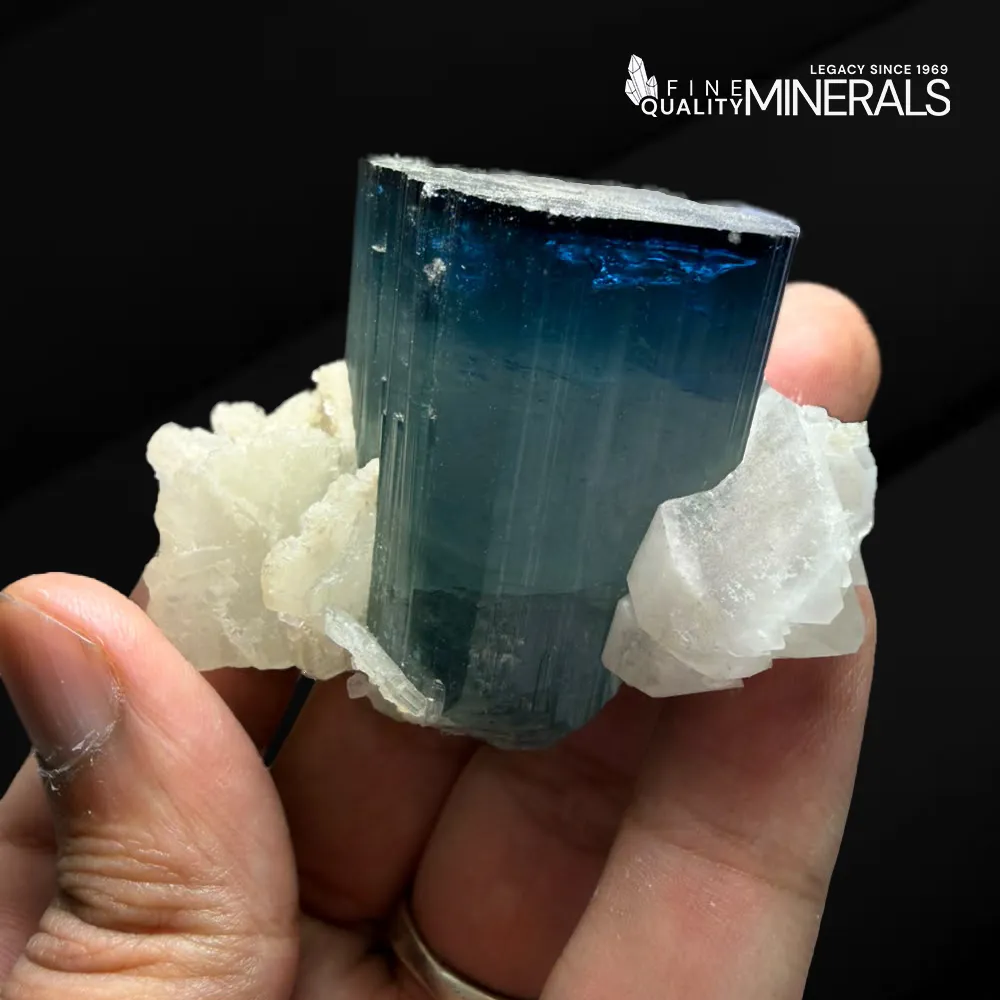
The Shigar Valley, Shengus, and the surrounding Skardu fields produce clean hexagonal prisms with glassy pinacoid terminations. Unlike commercial material from other parts of the world that requires heat treatment to develop a blue tint, Skardu aquamarine is naturally saturated by iron ions within the beryl structure. The crystals range from pale ice-blue to deep cyan.
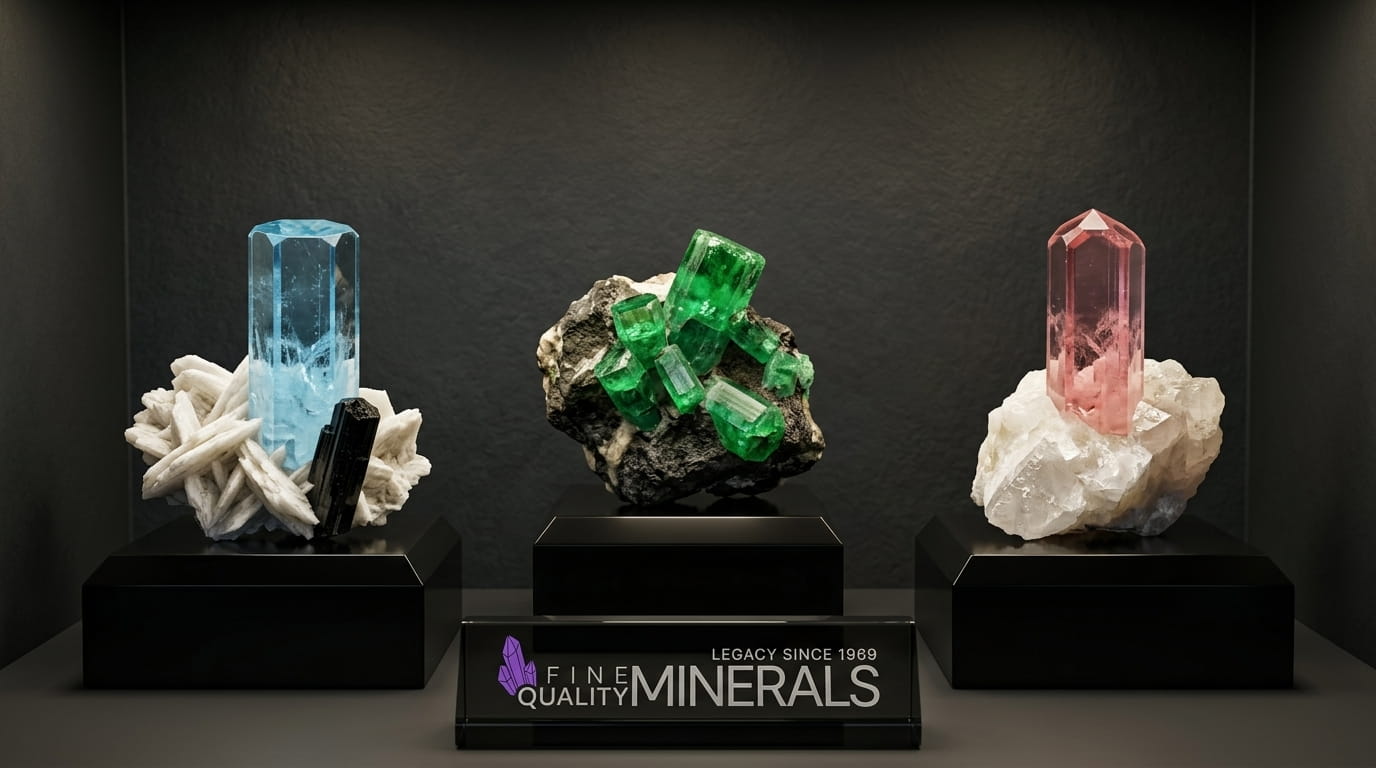
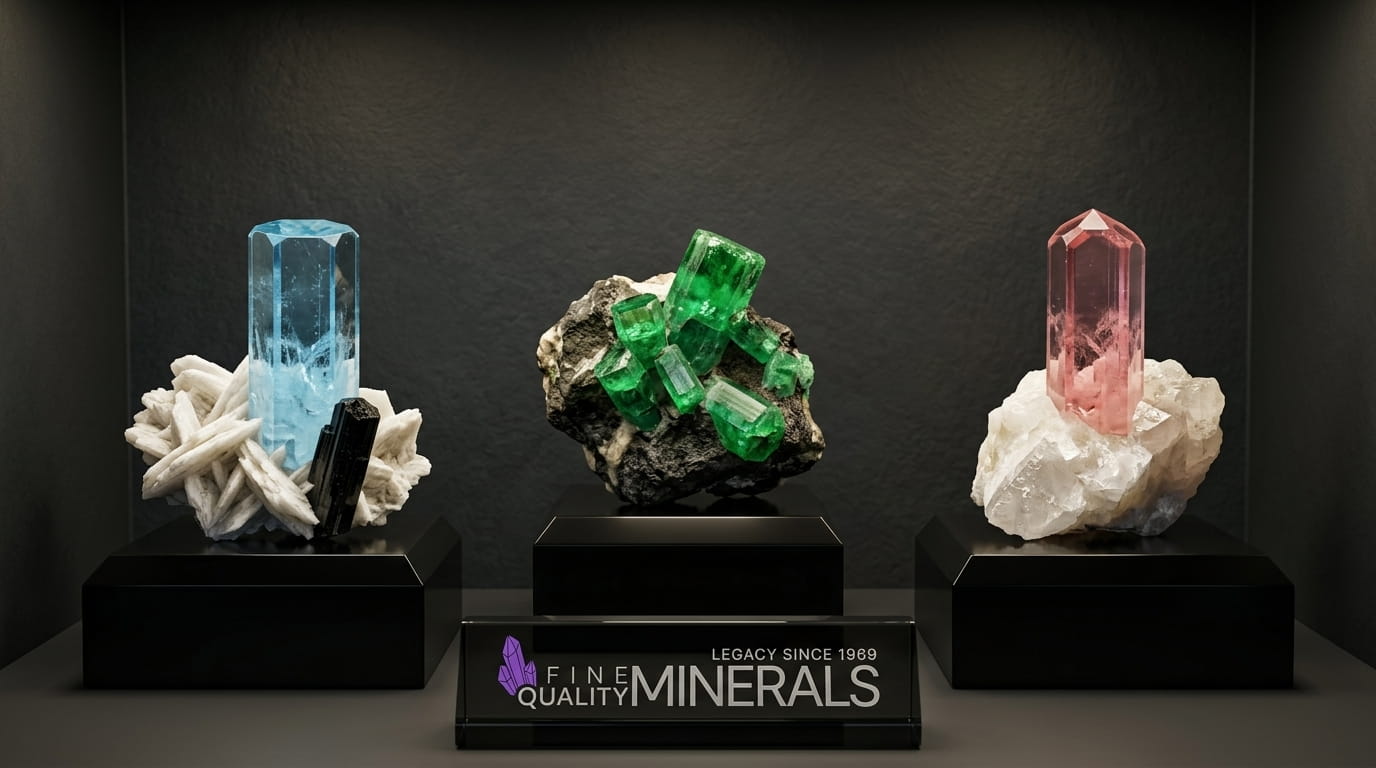
The best display pieces feature aquamarine crystals naturally anchored to bright white, bladed cleavelandite (a variety of albite) or books of silvery muscovite mica. Loose floaters are common, but intact matrix pieces with undamaged terminations command the highest collector demand. You can inspect authenticated pocket pieces in our aquamarine specimen inventory or review mineralogical data in our guide to natural aquamarine crystals.
Sassi, Haramosh, Dassu, and Khataro: Smoky Quartz and Pegmatite Formations
The Haramosh mountain range, along with the nearby valleys of Sassi, Dassu, and Khataro, contains dense concentrations of alpine cavities. Natural background radiation from surrounding granite acts on trace aluminum impurities inside the silicon dioxide structure, turning clear quartz into deep smoky quartz.
Smoky quartz from this region occurs as sharp, highly lustrous prismatic crystals, often displaying double terminations, gwindel growth habits, or skeletal etchings. Crystals range from light whiskey and tea tones to completely opaque black morion quartz.
Mineralogically, these locations stand out because the quartz crystals rarely form alone. Pockets at Dassu and Khataro often yield quartz associated with black schorl tourmaline needles, microcline feldspar, spessartine garnets, and small, gemmy fluorite cubes. These multi-mineral associations make specimens from the Gilgit-Skardu road reliable study pieces for alpine crystallization.
Dassu and Kohistan: Golden and Sherry Topaz
Beyond quartz and beryl, the Dassu area in the Shigar district and the rugged ridges of Kohistan host pegmatitic topaz deposits. Fluorine-rich hydrothermal solutions circulating through cooling granites allow aluminum silicate fluoride hydroxide crystals to grow into robust, prismatic forms.
Topaz from Dassu is known for sharp, wedge-like or pyramidal terminations and heavy, blocky habits. The colors range from clear, champagne, and honey-yellow to rich sherry amber. Under natural sunlight, some of these pegmatitic topaz specimens present distinct pleochroism, shifting between warm yellow and golden brown when viewed along different optical axes.
Because topaz has a Mohs hardness of 8 and a perfect basal cleavage, extraction requires careful hand chiseling. Pockets that survive without cleavage cracks or bruised edges are uncommon. Collectors value Dassu topaz most when it is preserved directly on a matrix of crystallized albite, quartz, or muscovite.
Katlang, Mardan: Naturally Pink Imperial-Type Topaz
About 50 kilometers north of Mardan in Khyber Pakhtunkhwa, the Ghundao hill near Katlang contains one of the only deposits on Earth that produces naturally pink topaz. Unlike pegmatitic topaz, Katlang topaz is hosted within calcite and quartz veins cutting through fractured Paleozoic limestone.
The crystals are colored by trace amounts of chromium, producing shades of baby pink, salmon, rose, and rare purplish-red. Most commercial pink topaz sold globally is clear topaz that has been artificially irradiated or coated. Katlang crystals are entirely natural and unheated.
Katlang crystals are typically small to medium in size, rarely exceeding 3 to 4 centimeters in length. They have a distinct modified prismatic shape, often ending in chisel-like terminations. Because they grow directly inside white calcite, the most desirable collector specimens show the pink crystal emerging from the contrasting white limestone matrix.
Swat Valley: Intense Green Chromian Emeralds
The emerald mines of the Swat Valley, centered around Mingora, sit directly along the Main Mantle Thrust. This suture zone forced chromium-bearing ultramafic ophiolites into contact with beryllium-bearing quartz-carbonate veins and talc-magnesite schists.
This collision created emeralds with exceptional color saturation. High concentrations of chromium give Swat emeralds an intense, vivid green that rivals fine Colombian emeralds, even in very small crystals. While most crystals from Mingora measure under 1 to 2 centimeters and contain natural two-phase fluid inclusions and fractures, their color intensity remains distinct under any lighting.
Fine mineral collectors prioritize Swat specimens that remain preserved on their dark, schistose or white quartz matrix. Intact clusters of hexagonal green prisms on gray-black talc schist provide strong contrast and verify authentic locality origin.
Zaggi Mountain, Hangu: Rare Scepters, Bastnäsite, and Quartz Varieties
Zaggi Mountain, located near Hangu and the tribal regions of Khyber Pakhtunkhwa, is a unique carbonatite and metamorphic environment. It is famous for producing unusual quartz habits alongside rare-earth minerals.
Quartz from Zaggi frequently forms scepters, reverse scepters, and complex window or skeletal patterns. Crystals range from water-clear to smoky and smoky-citrine tones. Hydrothermal solutions within these fractures also deposited rare carbonates, phosphates, and fluoro-carbonates.
The most famous accessory mineral from Zaggi is bastnäsite-(Ce), which occurs as tabular, lustrous, honey-orange to reddish-brown crystals directly attached to the quartz prisms. Pockets also yield xenotime, parisite, and rutile inclusions. For collectors interested in rare earth mineralogy, Zaggi specimens offer distinctive scientific and aesthetic value.
Locality and Mineral Summary
| Locality | Primary Mineral | Color and Variety | Host Environment |
|---|---|---|---|
| Skardu (Shigar, Shengus) | Beryl (Aquamarine) | Sky blue to sea green | Granitic pegmatite on cleavelandite |
| Sassi / Haramosh / Dassu | Quartz | Smoky, morion, gwindel | Alpine pegmatite cavities |
| Dassu / Kohistan | Topaz | Sherry, amber, golden | Pegmatite with albite and quartz |
| Katlang (Mardan) | Topaz | Natural pink, salmon, rose | Hydrothermal veins in calcite/limestone |
| Swat (Mingora) | Beryl (Emerald) | Deep chrome green | Talc-magnesite schist suture zone |
| Zaggi Mountain (Hangu) | Quartz / Bastnäsite | Smoky scepters, orange bastnäsite | Alkaline carbonatite fissures |
Frequently Asked Questions About Pakistan Gemstones and Minerals
Why are Pakistani pegmatite minerals so popular among international collectors?
The geological tectonic uplift in the Karakoram and Hindu Kush mountains left pockets relatively unweathered and preserved. Pockets produce large, well-crystallized minerals like aquamarine, tourmaline, and topaz naturally attached to clean, aesthetic matrix minerals like cleavelandite and muscovite.
Are Katlang pink topaz crystals naturally colored or heated?
Authentic Katlang pink topaz crystals are 100% naturally colored by trace chromium ions present during their formation in limestone-hosted hydrothermal veins. They do not undergo heat treatment or artificial irradiation.
What should a buyer check before purchasing an emerald specimen on matrix from Swat?
Check the junction where the emerald crystal meets the talc-schist matrix under magnification and UV light. Natural specimens will show clean, continuous mineral growth without evidence of synthetic adhesives, ground schist paste, or reconstructed matrix repairs.
Where is the primary marketplace for rough Pakistani mineral specimens?
The historic trading hub for minerals mined in northern Pakistan and Afghanistan is Namak Mandi in Peshawar. Artisanal miners and local traders bring fresh pocket discoveries directly to Peshawar for initial sorting, trimming, and trade.